Your Gift, Changing Futures: Championing African Studies at Oxford
The University of Oxford has a long and diverse engagement with Africa. Early scholarship focused on relations between the colonised and colonisers, and the impacts of colonialism on the continent. Over time, this evolved into more focused work in development studies and economics resulting in the establishment of the Centre for the Study of African Economies in 1993.
The founding of the African Studies Centre in 2004 further strengthened this commitment. It was incorporated into the School of Interdisciplinary Areas Studies (SIAS), now called the Oxford School of Global and Area Studies (OSGA), which is a department within the Social Sciences Division.
Recognising the need for intensive, interdisciplinary study of the continent, the African Studies Centre launched the MSc in African Studies in 2005. The programme enables students to engage deeply with global power asymmetries while examining the distinctive political, socio-economic, and cultural trajectories of African states and societies.
Today, the African Studies Centre brings together scholars, students, and partners from across Africa and around the world to generate knowledge that drives meaningful change. The Centre produces research that informs policy, shapes public discourse, and contributes to governance, development, environmental, and social initiatives both in Africa and globally.
African Studies and St Antony’s College
St Antony’s purpose is “to promote international understanding in a complex world.” It is Oxford’s most international college and a world-renowned hub for research and teaching in global and regional issues.
The College provides an interdisciplinary environment to study and research a range of subjects within the social sciences and humanities to deepen understanding of the key parts of the world.
The history of African Studies at Oxford is closely intertwined with the history of St Antony’s College. It became an important early focus for African Studies. This was mainly through the Rhodes Chair of Race Relations at the College in 1954. A College African Studies programme grew around the activities of the Chair, particularly weekly research seminars on African affairs, race and ethnicity, and later on the African environmental programme.
Alongside Africa, the College houses research centres focused on Asia, Europe, Japan, Latin America, the Middle East, and Russia and Eurasia.
As part of its 75th anniversary, the College has published an account of this shared history on its website, highlighting the central role African Studies has played in its intellectual life.
Scholarships and Visiting Fellows
Scholarship support for African students has been a major fundraising priority for St Antony’s College. The focus is on creating scholarship for students who did their first degree in low- and medium income countries listed by the Development Assistance Committee (DAC) of the Organisation for Economic Co-operation and Development as entitled to public development aid: the DAC Scholarship.
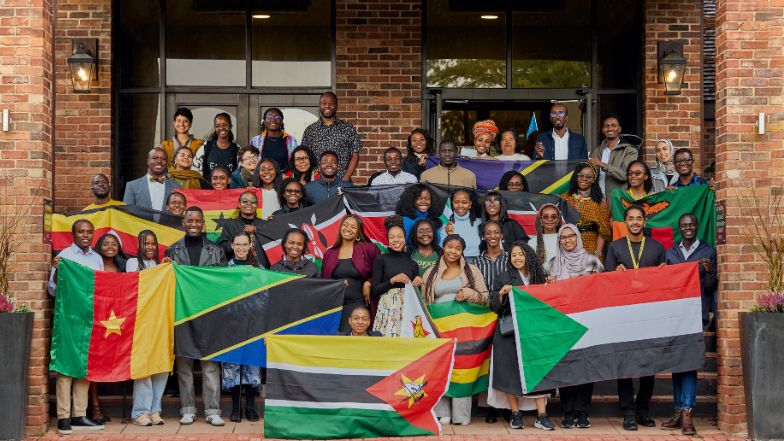
These sustained efforts have helped transform the composition of the MSc African Studies cohort. Today, approximately 60–65% of graduates are of African origin—a marked shift from the early years of the programme, when most students came from North America and Europe.
In 2018, the African Studies Centre partnered with the Africa Oxford Initiative (AfOx) to establish a Visiting Fellowship scheme. This programme enables faculty based at African institutions to spend time at Oxford conducting research.
Expanding African Studies in Oxford
Rhodes Must Fall and Black Lives Matter
The student protests between 2015 and 2021 were among the most significant in Oxford’s recent history and had a profound impact on the University. They sparked sustained debate about admissions, curriculum reform, representation, and the institution’s historical ties to colonialism.
In this context, the expansion of African Studies is fundamental. Increasing the number of academic posts focused on Africa and scholarships for African students, directly addresses questions raised about Oxford’s colonial legacies and supports the University’s bid to become a genuinely global research institution.
The Future
Africa is undergoing profound and complex change. Environment and climate change, public health provision, and the implications of the fast rise of Artificial Intelligence for African societies and politics, are three particularly urgent themes in African futures.
Many societies face overlapping pressures, including economic volatility, political fragility, and widening inequality. Rising debt burdens, food insecurity, and youth unemployment also constrain growth and stability.
At the same time, several African countries are experiencing sustained economic growth. The continent’s mineral and land resources are of global significance. Demographic projections suggest that African populations will increase most rapidly in the next few decades, some suggest reaching 2.5 billion or a quarter of humanity by 2050.
Educational attainment is expanding rapidly. Since the 1990s, democratic processes have spread—albeit unevenly—and many African states are playing increasingly active roles in global institutions. African cultural production, from literature and music to visual arts and film, is gaining global recognition and influence.
As an academic focus, African Studies now has inexhaustible literatures in multiple disciplines and a rich store in journals. Much theory in the social sciences tends to be homogenising, presenting western societies and social change as the norm, flattening out the distinctive trajectories of different regions. It is crucial to analyse and understand the distinctiveness of African trajectories, cultural formations, and agencies.


The ambition
Oxford has the ambition, and the responsibility, to become a world leader for the study of Africa. To expand research and teaching capacity, the African studies Centre and St Antony’s College are proposing the establishment of an endowed Associate Professorship in African Studies with three possible subject areas for this post:
- Environmental Studies and Climate Change in Africa: Focusing on the environmental challenges facing the continent, this field examines the impacts of climate change on African ecosystems, livelihoods and economies, while exploring sustainable practices and policy responses tailored to local contexts.
- Public Health in Africa: Focusing on health systems, disease prevention, and healthcare equity, this area investigates how African nations can address public health challenges and work toward improving health outcomes across diverse populations.
- Artificial Intelligence and African Societies: Focusing on the development and application of AI technologies in African contexts, this emerging field explores how to build foundational capabilities, fostering local innovation, establishing effective and ethical AI governance, and mitigating socio-economic disruption.
The Associate Professor will be a Governing Body Fellow of St Antony’s College, becoming part of a group of around 40 distinguished scholarships in the field of global or regional issues.
The opportunity
The African Studies Centre and St Antony’s College are seeking a donation of £4.1 million to endow this vital post in perpetuity and would welcome the opportunity to add the name of the donor or someone of their choosing to the name of the scholarship.
Donor recognition
St Antony’s College would not exist without the generosity of its benefactors; it was founded in 1950 as the result of a gift from Antonin Besse. The College recognises its donors in a variety of ways, and involves them in the life of St Antony’s on both a formal and an informal basis.
A Foundation Fellow is any person (or funding body such as a business or foundation) who has made gifts totalling more than £250,000 to the College or one of its Centres.
Oxford’s donor recognition scheme also applies to gifts made towards one of its constituent College, including St Antony’s. For more information, please see the Campaign Website of the University.